K2-18b: The Water Planet With Potential Living Organisms
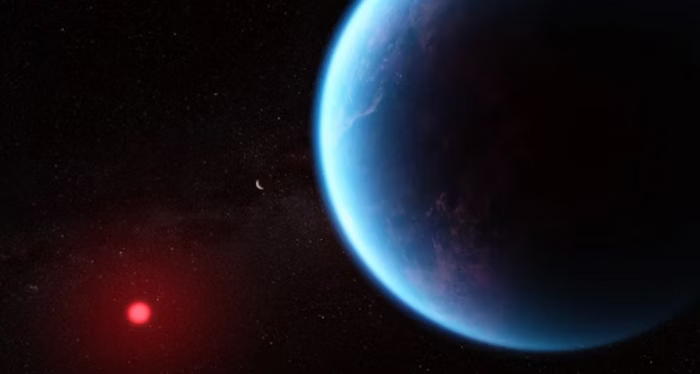
With NASA’s James Webb Space Telescope, scientists were able to confirm just recently that there is an extremely high chance of living organisms existing on a planet 120 light years away from Earth, nicknamed K2-18b.
Scientists from Cambridge were able to study samples of the atmosphere provided by the James Webb Space Telescope to identify signs of the molecules: dimethyl sulphide (DMS) and disulfide (DMDS). DMS and DMDS are gases produced by marine phytoplankton and bacteria. Through signs of water vapors, scientists hypothesize that K2-18B is a water-rich planet, with little or no land above water.
Though only speculated to contain life recently, K2-18b was discovered in 2015 and served as a poster child for a hypothetical category of planets that are larger than Earth but smaller than Neptune, called the “Hycean” worlds.
“Our findings underscore the importance of considering diverse habitable environments in the search for life elsewhere,” explained Nikku Madhusudhan, an astronomer at the University of Cambridge and lead author of the paper announcing these results. “Traditionally, the search for life on exoplanets has focused primarily on smaller rocky planets, but the larger Hycean worlds are significantly more conducive to atmospheric observations.”
The latest results for the percentage of certainly possible lives on K2-18B came back as 99.7%. Although this seems like a significant percentage, a majority of the scientific community is not convinced and will not be sure of this discovery until results are 99.99999999% accurate.