Perseid meteor shower to light up August skies under nearly moonless conditions
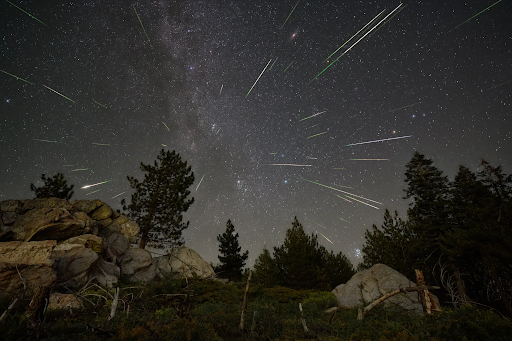
This year, one of the most awaited meteor showers of the year reaches its peak, promising stargazers in the Northern Hemisphere the opportunity to see meteors light up the sky for at least one minute every hour because the skies are extra dark during this time. This meteor shower is known as the annual Perseid meteor shower, and its peak occurs overnight from Aug. 12 through Aug. 13. Fortunately for stargazers this year, the peak happens on a new moon, which means there won’t be any bright moonlight washing out some faint meteors.
With this in mind, this year could prove to be the right time for observers to witness the Perseids. With no bright moon in the skies, under perfect viewing conditions far from the city lights, according to NASA, observers should expect to see 50 to 100 meteors every hour during the peak. The American Meteor Society indicates that Perseids start appearing in mid-July and end in late August.
What Causes the Perseids?
Even though they seem to be, these flashes are not falling stars. Perseids occur annually during the summer as Earth goes through the cloud of dust created by Comet 109P/Swift-Tuttle and produces streaks because of the fast speed at which these particles fall on Earth. According to NASA, the speed of Perseids is about 37 miles per second, and they are characterized by especially long-lasting fireballs.
Swift-Tuttle travels around the Sun for 133 years, and its last passage in the inner part of the solar system occurred in 1992. The next passage will happen only in 2126 but in order to see the Perseids, one does not have to wait until the appearance of Swift-Tuttle. There is material left behind during previous passages of the comet, and Earth crosses it annually.
Perseids have been observed by people for many years already, but the connection between meteors and comets was discovered in the 19th century. That is why what is seen on the ground as just a quick flash of light can be considered the remnants of the comet moving around the Sun.
When and Where to Watch
As its name suggests, the shower owes its name to the constellation Perseus, as the meteors are said to come from the same area of the sky, which is called by astronomers the "radiant" for the constellation. However, it is not necessary to identify the constellation in order to see the show as meteors may be seen from any place in the sky. Moreover, it might be beneficial to observe them from spots further away from the radiant, as the longer trails of meteors would be more visible at a greater distance from the point where they start.
For the best observation of the Perseid meteor shower, it would be most appropriate to view them in the Northern hemisphere during the hours before sunrise, as the radiant would be located the highest in the sky at this time. It would be necessary to go to the darkest spot, which would be away from any sources of light, and let your eyes adjust to darkness. No special equipment such as binoculars or telescopes would be needed, and their use might restrict the view, which would depend on weather conditions.
An Unusually Busy Week in the Sky
There are several other reasons why astronomers will be keeping watch this week beyond the Perseids meteor shower. The Aug. 12 date coincides with both a new moon and a solar eclipse. While there will be a total eclipse that crosses parts of Greenland, Iceland and northern Spain, there will be a partial eclipse seen by many more regions. There are also planets that will be visible in the early morning sky during this same period.
However, the Perseids will be unique due to the fact that little is needed for people to watch the display. As opposed to watching other far-away heavenly bodies or constellations in the night sky, all it takes to see the meteor shower is to be at a dark site, look up and wait. This year, in particular, with there being little moonlight, it will be easier to spot meteors. It will not be ending right after Aug. 13. The Perseids will slowly taper off from the latter part of August, thus giving people more time if the sky is cloudy when it reaches its peak period. However, since there will be plenty of meteor activity accompanied by a completely dark moon, Aug. 12 and 13 could be the best time this year to witness some parts of a centuries-old comet brighten up the night sky on Earth.